
Taking Time to Pause…
Mindfulness and Art in the Therapeutic Space
Practicing mindfulness can really be as simple as pausing to notice…your breath, a feeling within you, or the smells, sounds, and sights around you.
Jon Kabat-Zinn, a scientist, professor, and one of the key figures who helped bring mindfulness into Western culture, defines mindfulness as “the awareness that arises through paying attention, on purpose, in the present moment, and non-judgmentally.”
So, pausing is a part of this practice. Pausing to notice what we think, feel, and sense.
When we practice mindfulness regularly, we can become more attuned to ourselves, which can help us feel more regulated and better able to navigate stressful situations and experiences within our relationships. And on the flip side, mindfulness can also increase our capacity to experience joy, connection, and meaning—both internally and within our relationships.
As a therapist, mindfulness is one of the resources I offer for clients. It can be beneficial for a range of concerns and struggles, and it can also help us create more space to notice and appreciate the positive moments in our lives.
Key principles of mindfulness include non-judgment, patience, beginner’s mind, trust, non-striving, acceptance, and letting go. As I work with clients on developing a mindfulness practice that feels meaningful and manageable for them, we may explore each of these ideas and find practical ways to apply them in everyday life.
For example, with non-judgment, we may notice whether self-criticism or blame are themes in the way they talk to themselves. From there, we can begin to practice responding to ourselves with greater compassion.
Some examples of how I guide clients in practicing mindfulness include breathing exercises, sensory awareness activities, and Art Therapy.
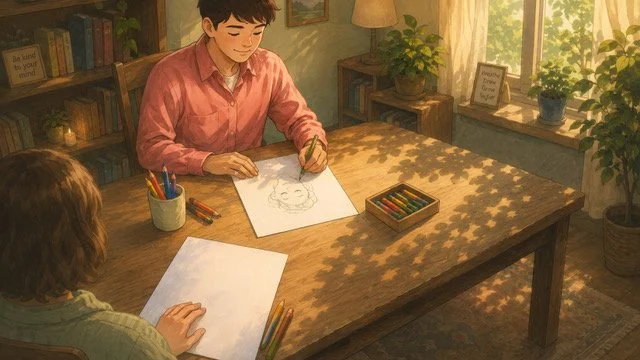
Art making can also be a practice of mindfulness. Creating art invites us to slow down and become present with what is happening in the moment. We may notice things like the feel of the materials in our hands, the colors we are drawn to, and thoughts and emotions that arise as we create. The creative process can strengthen the connection between mind and body, and art therapy can provide a safe outlet for processing experiences through this creative process, which can then lead to a deeper understanding of ourselves and the world around us.
The creative process gives us an opportunity to pause, notice, and simply be with our experience. And with Art Therapy, there is no pressure to be or make something in a specific way. The process itself is what facilitates much of the healing. I often think of the expressive arts therapist Dr. Jamie Marich and her book, Process Not Perfection, which captures this idea so well.
In this way, Art Therapy provides an opportunity to practice non-striving. Instead of focusing on creating something “good” or “right,” we can learn let go of expectations and instead become curious about the process and what emerges. There is no right or wrong. Whatever shows up is valuable.
The pause can also help us notice something we may not have been aware of before. Both the process and the final creation can open new doors into our internal world that then allow us to confront any difficult experiences or memories and begin our road towards healing.
And at other times, the pause can give us a much-needed moment to step away from the demands of our lives and reconnect with ourselves.
For me, this is one of the beautiful things about mindfulness and Art Therapy: both invite us to slow down enough to notice and appreciate what is already there.
Mindfulness isn’t necessarily about eliminating difficult thoughts or emotions. It’s about creating more space between what we experience and how we respond. Art can offer a similar pause, allowing us to slow down and explore feelings rather than avoiding them or feeling the need to fix or correct ourselves.
Sometimes, we don’t need to immediately solve what we’re feeling. Sometimes we first need to pause long enough to notice it.
Christine Lozano | MA, LCPC, ATR-BC, CCTP, Psychotherapist
images by Superflai